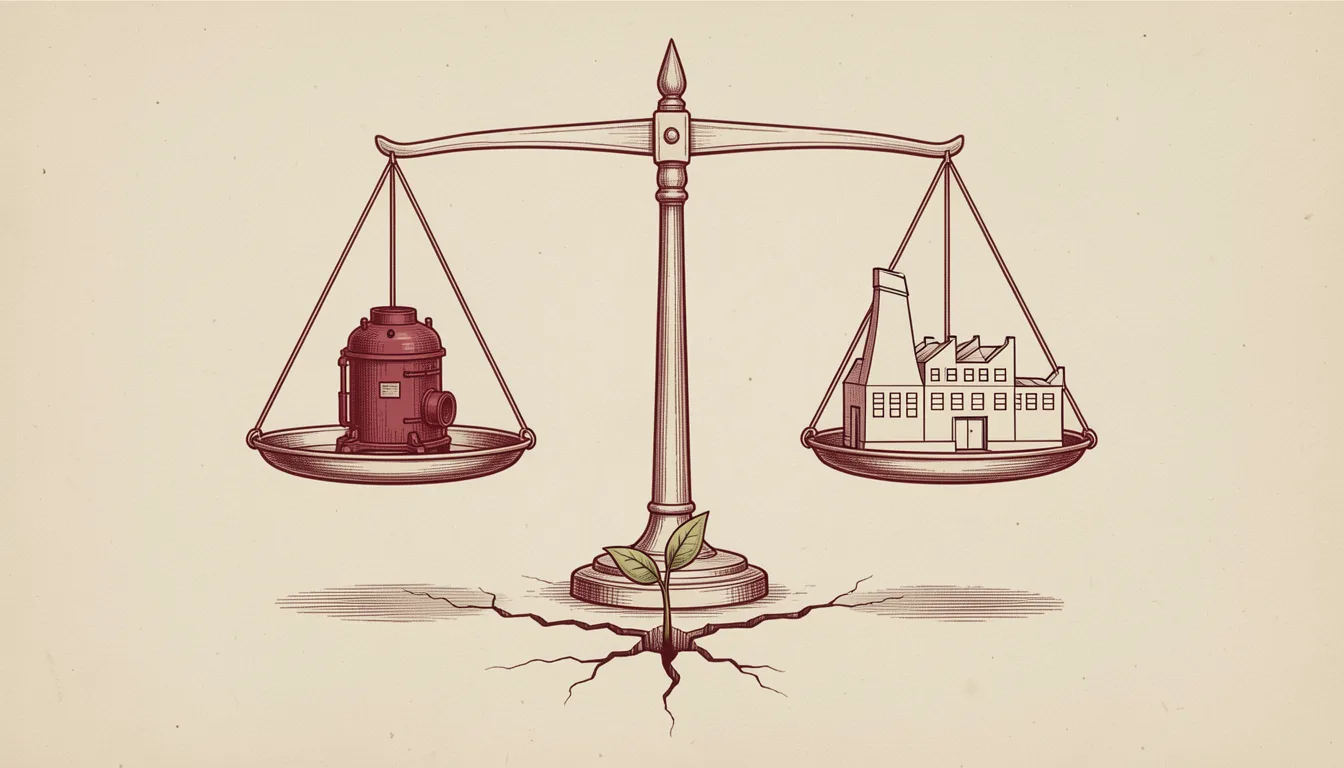
Refinyx Bought Northvolt's Assets Without Repeating Its Balance Sheet
A second-act startup can buy patents and a small pilot from a bankruptcy estate, then license the technology instead of owning a factory.
If you are planning a second company after a failure, treat the bankruptcy estate as a menu, not a company to copy. The battery-recycling startup Refinyx was created in March 2025, the same month Northvolt entered bankruptcy. Four of its co-founders had been on the senior team at Northvolt Revolt, Northvolt's recycling division.
Proof is the asset, not the plant
The estate can hold patents, equipment, leases, contracts, and a factory with a cost problem. Ask which item proves the technology without importing the operating model that failed. A patent protects a process; a pilot shows it works; a plant mostly shows how much it costs to run.
Before you bid, ask who can enforce the patents, whether the pilot hardware is transferable, and whether the process depends on a person rather than a documented method. A failed company often has key know-how trapped in a small group. The new company needs that know-how in writing, or it has bought a story.
- Map the estate before you bid. Make a short list separating intellectual property, pilot hardware, customer contracts, and production capacity. For each item, note what it proves, what it costs to maintain, and who can use it. Price proof, not the company.
- Buy the smallest package that proves the technology. Refinyx obtained 134 patents and a pilot site in Västerås under the deal. The result is a portfolio you can defend, a site you can run, and a process you can show to an operator. If the package needs a factory to make sense, it is probably too large.
- Keep the pilot small enough to fail cheaply. Refinyx is operating a €435,000 Alfa Laval pilot project at its 1,200-square-metre Loophouse site in Västerås. The pilot is ready when it can stop, change, or scale without new construction. Track yield, energy use, downtime, and operator interest before you talk about a commercial plant.
- License to operators instead of building capacity. Refinyx intends to license its battery-recycling technology to industrial operators rather than build or operate its own plants. The agreement should show that the operator owns the plant and the startup owns the process. Training, support, and a clear path to revenue belong in the license.
- Fund the acquisition from patient capital, not growth debt. Qarlbo Energy and Thisbe, a Wallenberg Foundation subsidiary, financed Refinyx's acquisition. The funding should allow the team to wait for pilot data, not demand a factory by a date. Investors need to understand that the asset is proof, not production.
The trap is a cheap plant
A failed factory can look like a bargain, but it brings maintenance, labor, energy, and local obligations. If the unit economics have not been proven, the plant becomes another failure with a roof. The same mistake can hide in a lease, a service contract, or a promise to keep a team employed. Ask what the asset requires before you ask what it can produce.
A cheap plant can also pull the team into daily operations before the technology is ready. Founders should be able to say no to a production date if the pilot has not earned it.
Licensing turns capacity into revenue
Licensing changes the startup's job from building to supplying process know-how. The operator carries the capital cost; the startup carries the proof. That split can be attractive when the technology is real but the market is not ready for a full plant.
The startup still needs a way to earn from the process, whether through a royalty, a service fee, or a milestone tied to performance. It also needs a way to keep the operator from copying the method and dropping the agreement. The operator needs a reason to keep the license. If the process is easy to reverse-engineer, stronger protection, better service, or a faster path to a better version becomes the startup's leverage.
The buy-proof-license rule: buy the patents and a small pilot, then license the process to industrial operators. Do not own production capacity until the pilot proves the unit economics.